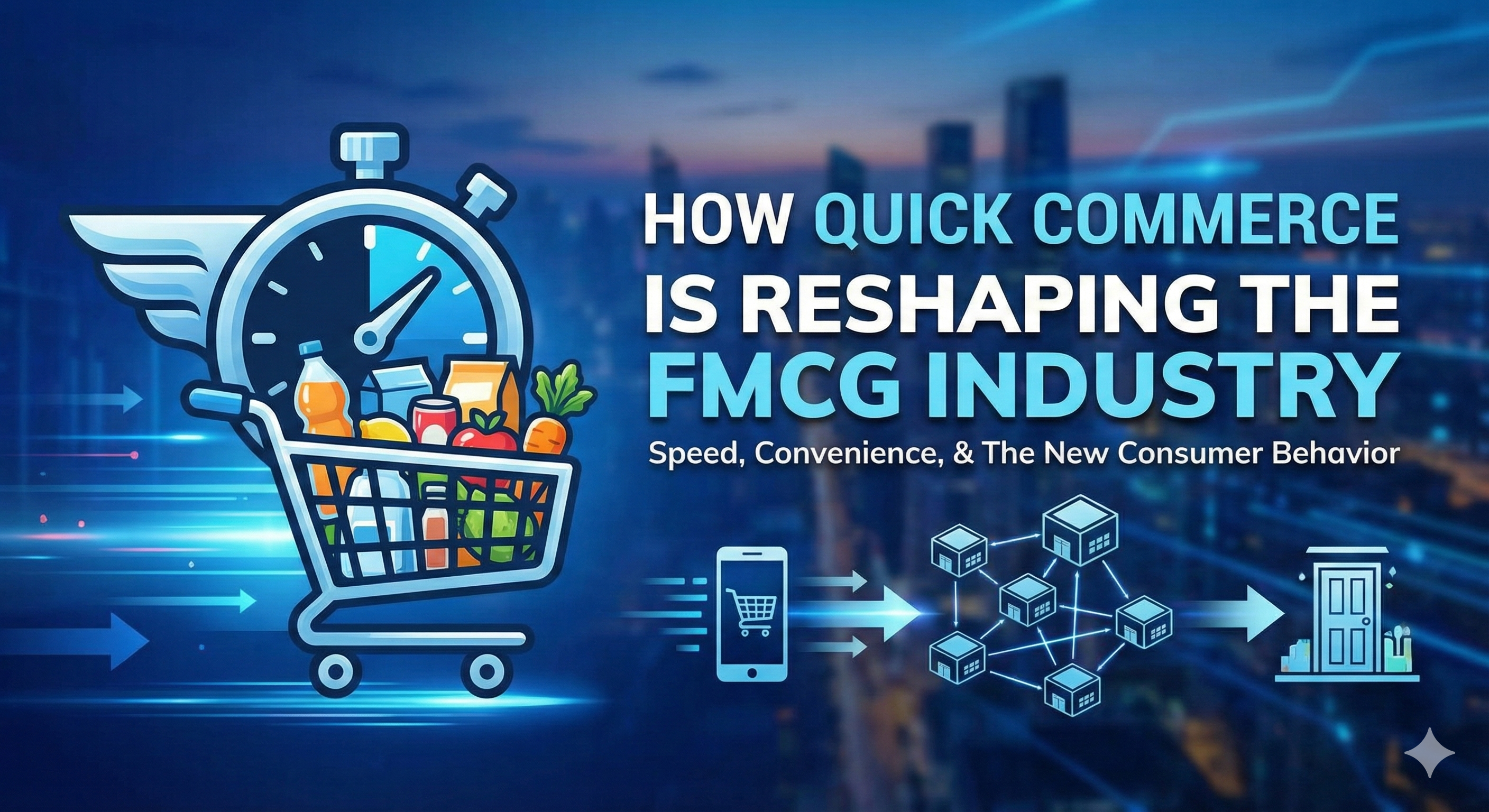
Quick commerce—often called q-commerce—is rapidly transforming how consumers buy everyday essentials. With delivery timelines shrinking from days to minutes, the Fast-Moving Consumer Goods (FMCG) industry is being pushed to rethink margins, supply chains, retail formats, and go-to-market strategies. What began as a convenience-driven trend is now becoming a structural shift, especially in urban and semi-urban markets.
Below is a closer look at how quick commerce is affecting the FMCG landscape.
1. Low Margins, High Volumes: A New Sales Equation
One of the most immediate impacts of quick commerce on FMCG companies is margin pressure. Instant delivery platforms demand competitive pricing, frequent promotions, and higher trade margins to remain attractive to consumers.
While per-unit profitability may decline, this is often offset by a sharp increase in sales volume. Faster consumption cycles, impulse buying, and frequent reordering mean brands can achieve scale much quicker than through traditional retail alone. For FMCG players, success in quick commerce is less about margin per SKU and more about velocity, visibility, and repeat purchases.
2. Growth of Instant Grocery Platforms Driven by the Middle Class
The expansion of the middle class—particularly in developing economies—has accelerated the adoption of instant grocery platforms. Time-constrained, digitally savvy consumers increasingly prefer home delivery over physical shopping trips.
As disposable incomes rise, convenience is no longer a luxury; it is an expectation. Quick commerce platforms meet this demand by offering curated assortments, reliable delivery times, and seamless app experiences. For FMCG brands, these platforms represent a fast-growing channel that cannot be ignored, especially for urban penetration and brand trials.
3. Surge in Market Followers and New Entrants
The rapid success of early quick commerce players has triggered a wave of followers entering the market. This surge is driven by perceived opportunities in logistics innovation, private labels, and data-driven consumer insights.
For the FMCG industry, this means:
- Greater bargaining power shifting toward platforms
- Increased competition for digital shelf space
- The need for differentiated packaging, pricing, and promotions
While competition intensifies, it also expands the overall market, giving brands more touchpoints to reach consumers.
4. Decline in Traditional Retail Outlets
As consumers shift toward instant delivery, footfall in small neighborhood stores and some conventional retail outlets is expected to decline. This does not mean physical retail will disappear, but its role will change.
FMCG companies may reduce dependence on fragmented retail distribution and focus more on centralized fulfillment models. Retailers that fail to integrate technology, delivery partnerships, or omnichannel strategies risk losing relevance in the long term.
5. Hypermarkets Benefit from Discount-Led Shopping
Interestingly, while smaller outlets face pressure, large-format hypermarkets may see increased sales. These stores often position themselves as value destinations, offering bulk discounts that quick commerce platforms struggle to match consistently.
Consumers are likely to split their shopping behavior:
- Quick commerce for urgent, top-up, and convenience purchases
- Hypermarkets for planned, monthly, or bulk shopping
For FMCG brands, this dual behavior means maintaining distinct pricing and promotion strategies across channels.
6. Shift Toward Dark Store–Led Supply Chains
Perhaps the most significant structural change is the diversion from conventional retail supply to dark store–based fulfillment. Instead of supplying thousands of individual stores, FMCG companies increasingly cater to centralized dark stores designed solely for rapid picking and delivery.
This shift offers several advantages:
- Better demand forecasting through real-time data
- Reduced last-mile complexity
- Faster new product launches and testing
However, it also requires changes in packaging, case sizes, and inventory planning. Brands that adapt quickly will gain a competitive edge in speed and availability.
Final Thoughts
Quick commerce is no longer a niche channel—it is reshaping the FMCG industry at its core. While it brings challenges such as margin pressure and channel conflict, it also unlocks growth through higher volumes, better consumer insights, and innovative supply chains.
For FMCG companies, the future lies in embracing a hybrid model: balancing quick commerce, hypermarkets, and evolving retail formats while reengineering supply chains around speed and flexibility. Those who adapt early will not just survive the shift—they will define the next phase of the industry.